

Introduction
Fatty acid identification and quantification underpin nutrition, disease research, and translational studies across diverse matrices—plasma and tissues, edible oils, and processed foods. This guide compares GC-FID, GC-MS, and LC-MS/MS for quantitating saturated vs unsaturated fatty acids, with emphasis on sensitivity, isomer resolution, throughput, and compliance-aligned deliverables.
We frame workflows using LIPID MAPS nomenclature (e.g., FA 18:1(9Z), Δ positions, n/ω series) and validation language aligned to ICH M10/FDA/EMA for bioanalytical chromatographic methods. For formal nomenclature conventions, consult the LIPID MAPS nomenclature portal and the Journal of Lipid Research shorthand update by Liebisch et al. (2020), summarized on LIPID MAPS fatty acyls guidance.
Saturated vs Unsaturated Fatty Acids: Method Selection at a Glance
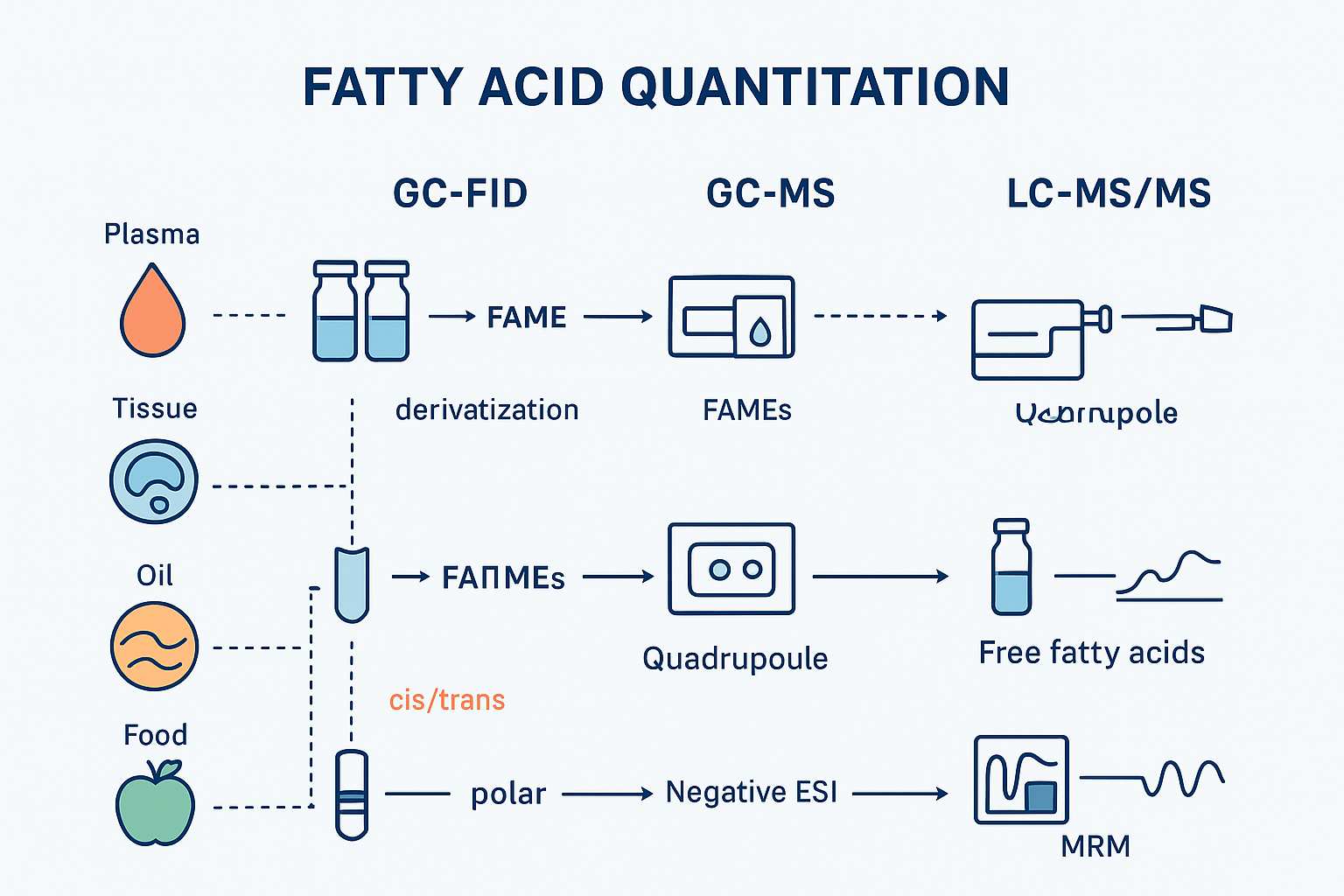
Choosing between GC-FID, GC-MS, and LC-MS/MS depends on matrix, target analytes (free fatty acids vs FAMEs), required isomer resolution (cis/trans and positional), sensitivity, and reporting needs. In other words, when you compare and contrast saturated and unsaturated fatty acids in real projects, instrument choice should map to goals, not habit.
Define project goals and matrices
Clarify whether you need routine profiling in oils/food, clinical-grade quantitation in plasma/tissue, or mechanistic studies requiring isomer resolution. Oils and food products often favor GC routes (FAMEs), while plasma/tissues with free fatty acids (FFAs) trend toward LC-MS/MS.
Sensitivity, specificity, and isomer resolution
- GC-FID delivers robust quantitation of FAMEs with wide linear ranges.
- GC-MS adds identification confidence via libraries, retention indices, and ion ratios; highly polar columns can separate cis/trans and positional isomers.
- LC-MS/MS (negative ESI, scheduled MRM/SRM, deuterated internal standards) typically provides the highest sensitivity for FFAs and trace species.
Throughput, timelines, and compliance
For large cohorts, scheduled MRM/SRM in LC-MS/MS scales efficiently. GC-FID supports high-throughput FAME profiling with predictable runtimes. Whatever you choose, plan for ICH M10–aligned validation and audit-ready reporting (calibration levels, accuracy/precision, selectivity, stability, ISR) to enable cross-study comparability. For clarity on expectations and terminology, see the ICH M10 training materials (2024) and the EMA ICH M10 FAQ.
At-a-glance method comparison
| Criterion | GC-FID | GC-MS | LC-MS/MS |
|---|---|---|---|
| Typical targets | FAMEs in oils/foods; routine profiling | FAMEs with enhanced ID (trace/speciation) | Free fatty acids in plasma/tissues; trace targets |
| Sensitivity | High for majors; broad linearity | Higher specificity; good sensitivity (SIM/SRM) | Highest for FFAs (neg. ESI; scheduled MRM) |
| Isomer resolution | Strong on polar columns (cis/trans) | Strong; plus spectral confirmation | Requires add-ons (PB/OzID/epoxidation) for C=C location |
| Derivatization | Required (FAME) | Required (FAME) | Generally not required |
| Runtime/throughput | Short–moderate; high throughput | Moderate; longer when maximizing ID | Moderate; high throughput with scheduled MRM |
| Cost/complexity | Lower | Moderate | Higher (instrumentation, ISTD panels) |
Quantitative decision rules
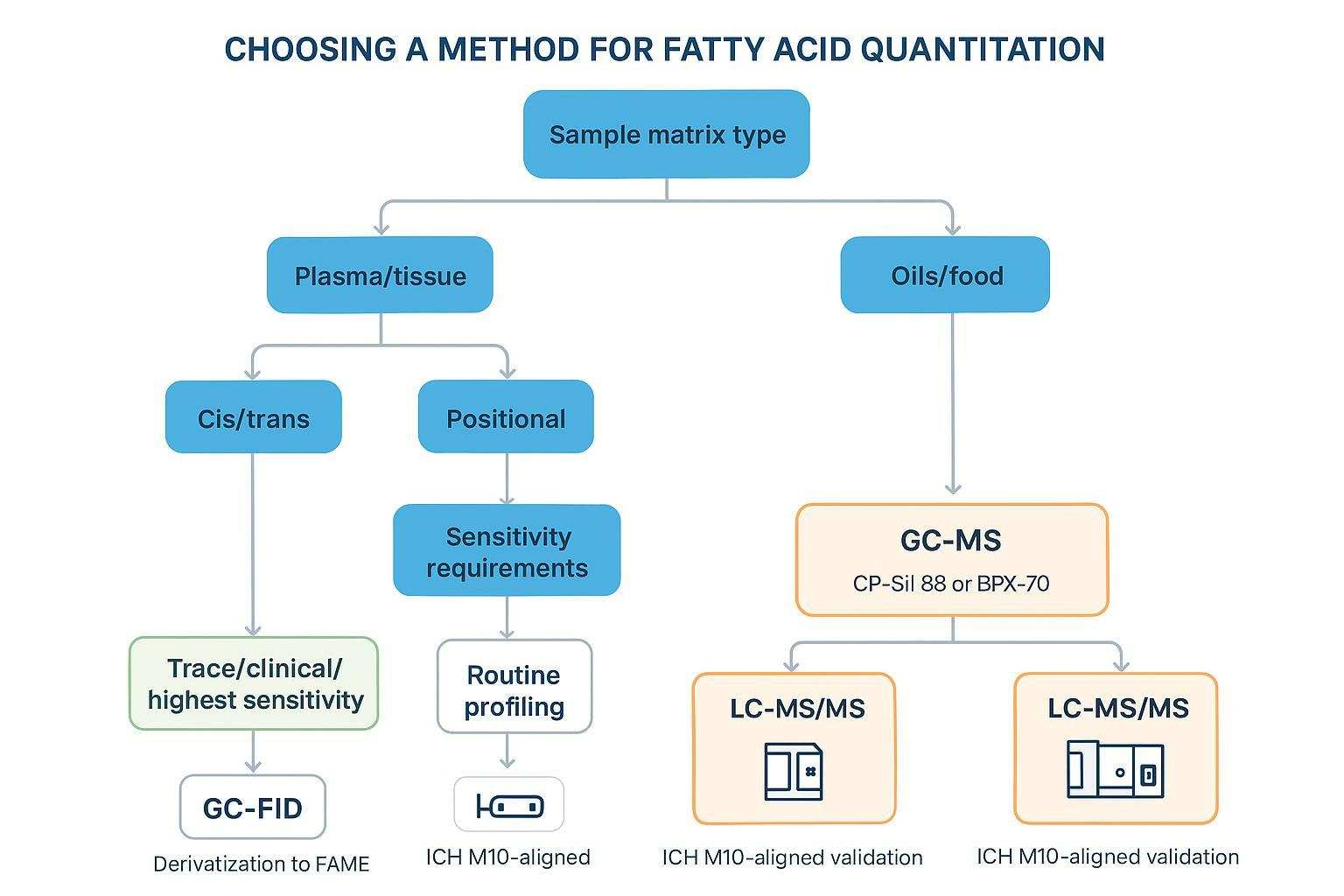
- Plasma FFAs expected below ~1 μM (≈100–200 ng/mL for common C16–C18 FAs): favor LC‑MS/MS (negative ESI, scheduled MRM) for best sensitivity and minimal derivatization.
- Sample matrices with very high total lipid content (edible oils, >80–90% total FAs by weight): favor GC‑FID for bulk FAME profiling and routine percent‑composition.
- When cis/trans or positional isomer separation is required: prioritize polar GC columns (CP‑Sil 88/BPX‑70) and GC‑MS confirmation.
- Trace‑level targets (<ng/mL) or complex suppression-prone matrices: prioritize LC‑MS/MS with deuterated ISTDs.
Worked example: 0.5 μM oleic acid (MW 282.47 g·mol⁻¹) = 0.5×10⁻6 mol·L⁻1×282.47 g·mol⁻1 = 141 ng·mL⁻1, which supports an LC‑MS/MS workflow when sub-μM sensitivity is needed.
Sample preparation and derivatization
Fatty acid workflows begin with extraction and, for GC routes, derivatization to FAMEs. The choice depends on matrix lipid content and downstream method.
Extraction strategies
- Folch (chloroform:methanol 2:1) for high-lipid matrices; comprehensive recovery across classes.
- Bligh–Dyer (chloroform:methanol:water) for low-lipid matrices; efficient solvent use.
- Hexane-based extraction for oils and high-fat samples; ideal for non-polar fractions and GC analysis.
For deeper SOP-style guidance on lipidomics extraction, see the method education page: sample preparation techniques in lipidomics analysis.
FAME formation: acid/base methanolysis, automation, oxidation control
- Acid methanolysis (e.g., methanolic HCl/H2SO4) provides broad esterification coverage.
- Base methanolysis (e.g., sodium methoxide) enables rapid transesterification; often paired with a follow-up acid step.
- Automation and oxygen-free handling (amber vials, PTFE-lined caps, deoxygenated solvents) limit oxidation artifacts.
If your project requires turnkey FAME workflows and cis/trans profiling, see the service page: FAME analysis.
Column selection: CP-Sil 88/BPX-70 and program tuning for isomers
Polar phases such as CP-Sil 88 and BPX-70 separate cis/trans and positional isomers. Long columns (50–100 m), thin films, and slow oven ramps (2–10°C/min) help resolve critical pairs.
| Column (polar phase) | Typical use case | Notes on programming |
|---|---|---|
| CP-Sil 88 | Cis/trans resolution in complex FAME mixes | Long columns; slow ramps improve separation |
| BPX-70 | Positional isomer separation; broad temperature range | Flexibility for diverse FAME panels |
| SP-2560/HP-88 | Routine food/oil profiling; standards-based methods | Common in AOCS/AOAC workflows |
GC-FID and GC-MS for FAME profiling
Isomer resolution: cis/trans and positional separation on polar phases
Highly substituted cyanopropyl phases (CP-Sil 88, BPX-70, SP-2560, HP-88) enable cis/trans and positional isomer separation. Oven programs should be tuned to the analyte mix—slower ramps often improve the resolution of critical pairs.
Identification confidence: libraries, retention indices, ion ratios
In GC-MS, combine library spectra (e.g., NIST/Wiley FAMEs), retention indices (Kovats or linear), and ion ratio criteria (SIM/SRM) to strengthen specificity. GC-FID quantitation is robust, and identification is supported by retention times and co-injection standards. For an instrument primer, see the method education page: GC-MS overview.
Sensitivity, runtime, and cost trade-offs
GC-FID offers cost-effective, high-throughput quantitation for FAMEs, typically with shorter runtimes and simpler maintenance. GC-MS improves identification confidence but may require longer runs and more complex operation. When profiling cis/trans or positional isomers at scale, GC routes often balance throughput and resolution effectively. For project planning around saturated vs unsaturated fatty acids in food oils, these trade-offs are especially practical.
LC-MS/MS for free fatty acids and trace targets
Negative ESI, scheduled MRM/SRM, deuterated ISTDs
For FFAs, LC-MS/MS in negative ESI with scheduled MRM/SRM provides sensitive quantitation without derivatization. Use a deuterated internal standard panel spanning chain lengths and degrees of unsaturation to correct matrix effects.
Limits of detection, matrix effects, and selectivity
Expect sub-ng/mL LODs/LOQs in optimized assays; verify suppression/enhancement via matrix-matched calibration and QC evaluation. Practical mitigations include post-column infusion to map suppression zones, robust sample cleanup, and matrix-matched calibration curves.
Double-bond localization options (PB, OzID, epoxidation)
For structural questions, PB derivatization (diagnostic fragments in CID) is routine-friendly; OzID provides high specificity but requires instrument modifications; epoxidation or DMDS/DPDS adducts offer lower-cost alternatives.
For background on FFAs concepts and measurement approaches, see the education resource: free fatty acids—structure, functions, and measurement.
Worked example — LC‑MS/MS for a plasma FFA panel
- Project: quantitate free fatty acids (C16–C18) in human EDTA plasma for translational biomarker screening.
- Platform/mode: UHPLC‑MS/MS (negative ESI), scheduled MRM.
- Internal standards: a deuterated panel (e.g., d5‑16:0, d7‑18:1, d5‑18:2) matched across chain lengths.
- Expected sensitivity (illustrative): LOQ ≈ 0.5–10 ng/mL (method/analyte dependent); LOD lower.
- Validation priorities: matrix‑matched calibration (≥6 levels), LLOQ/low/med/high QCs, stability (bench, freeze–thaw), and ISR (±20% for ≥2/3).
QA/QC, validation, and reporting deliverables
Calibration, internal standards, precision/recovery, stability
Plan calibration across ≥6 levels spanning your range, with acceptance of back-calculated values within ±15% (±20% at LLOQ). Use deuterated internal standards across chain lengths and degrees of unsaturation; verify accuracy/precision (≤15% CV; ≤20% at LLOQ) within- and between-run. Demonstrate selectivity in ≥6 matrix lots and stability (bench-top, processed, freeze–thaw, long-term). Include Incurred Sample Reanalysis (ISR) with differences within ±20% for ≥2/3 of reanalyzed samples. See the ICH M10 training deck (2024) for official definitions and examples.
Reporting: units, validation metrics, data dictionaries, nomenclature
Report in μmol/L or nmol/g, define LOD/LLOQ basis (signal-to-noise or precision-based), and provide data dictionaries mapping analyte names to LIPID MAPS shorthand (e.g., FA 18:1(9Z)), including Δ positions and n/ω classification. Clearly state cis/trans resolution conditions (column, oven program) and include validation metrics tables. For nomenclature consistency, reference the LIPID MAPS fatty acyls guidance.
Compliance alignment and cross-method comparability
Use compliance-safe phrasing such as "ICH M10–aligned acceptance criteria" for chromatographic methods (LC-MS/MS, GC-MS) and avoid accreditation claims. Cross-method comparability is often strong for major FFAs (GC-FID vs LC-MS/MS), while LC-MS/MS offers improved selectivity for low-abundance species.
Creative Proteomics supports compliance-aligned reporting with standardized data dictionaries, pooled-QC tracking, and figures ready for publication (e.g., chromatograms, heatmaps), helping teams produce audit-friendly deliverables without implying certification.
Conclusion
Map methods to common use-cases: GC-FID for high-throughput FAME quantitation in oils/food; GC-MS when identification confidence or detailed cis/trans and positional isomer resolution is needed; LC-MS/MS for direct FFAs quantitation in plasma/tissues and trace targets. The decision hinges on matrix, sensitivity, specificity, and reporting requirements. Standardized nomenclature and ICH M10–aligned validation ensure reproducible outcomes and cross-study comparability.
FAQs
What are the differences between saturated and unsaturated fatty acids in method selection?
Saturated vs unsaturated fatty acids differ by double bonds; GC-FID/GC-MS excel at profiling FAMEs and resolving cis/trans isomers, while LC-MS/MS is preferred for direct FFAs and trace analysis.
Unsaturated fatty acid vs saturated fatty acid: which instrument is most sensitive?
LC-MS/MS in negative ESI typically achieves the highest sensitivity for FFAs. GC-MS enhances identification for FAMEs; GC-FID is robust for routine quantitation.
Difference between saturated and unsaturated fatty acids: do I need derivatization?
GC routes require FAME derivatization. LC-MS/MS generally analyzes FFAs without derivatization.
How do I compare and contrast saturated and unsaturated fatty acids when I need isomer resolution?
Use polar GC columns (CP-Sil 88, BPX-70, SP-2560/HP-88) with tuned oven programs to separate cis/trans and positional isomers; LC-based double-bond localization (PB/OzID) answers positional questions when needed.
Which validation criteria align with ICH M10 for chromatographic fatty acid methods?
Calibration (≥6 levels; ±15% accuracy; ±20% at LLOQ), precision (≤15% CV; ≤20% at LLOQ), selectivity (≥6 matrices), stability (bench-top, processed, freeze–thaw, long-term), and ISR (±20% for ≥2/3 samples).
How should I select internal standards for LC-MS/MS FFAs?
Use a deuterated ISTD panel across chain lengths/unsaturation; assess matrix effects via matrix-matched calibration and QC performance.
Can LC-MS/MS and GC-FID results be compared directly?
For major FFAs, cross-method comparability is often good when validation and calibration are aligned; LC-MS/MS offers added selectivity for low-abundance species.
References:
- Liebisch, G., Fahy, E., Aoki, J., et al. "Update on LIPID MAPS classification, nomenclature, and shorthand notation for MS-derived lipid structures." Journal of Lipid Research 61.12 (2020): 1539–1555. https://doi.org/10.1194/jlr.S120001025
- Ruiz‑López, N., Benvenuti, G., & Ruiz‑Álvarez, M. "LC–MS/MS versus TLC plus GC methods: Consistency of glycerolipid and fatty acid profiles in microalgae and higher plant cells." PLOS ONE 12.8 (2017): e0182423. https://doi.org/10.1371/journal.pone.0182423
- Fan, Y., Wang, K., & Zhang, L. "A strategy for accurately and sensitively quantifying free fatty acids by isotope-coded derivatization and LC–MS/MS: method development and validation." Frontiers in Nutrition 9 (2022): 977076. https://doi.org/10.3389/fnut.2022.977076
- Zhang, Y., Borràs, E., & Li, H. "A validated GC–triple quadrupole MS method for quantification of fatty acid methyl esters in biological matrices." ACS Omega 6.3 (2021): 2047–2057. https://doi.org/10.1021/acsomega.0c03874